
 Facebook
 Twitter


 Gmail
Gmail

Abraham Storck
Amsterdam 1635 - Amsterdam 1710
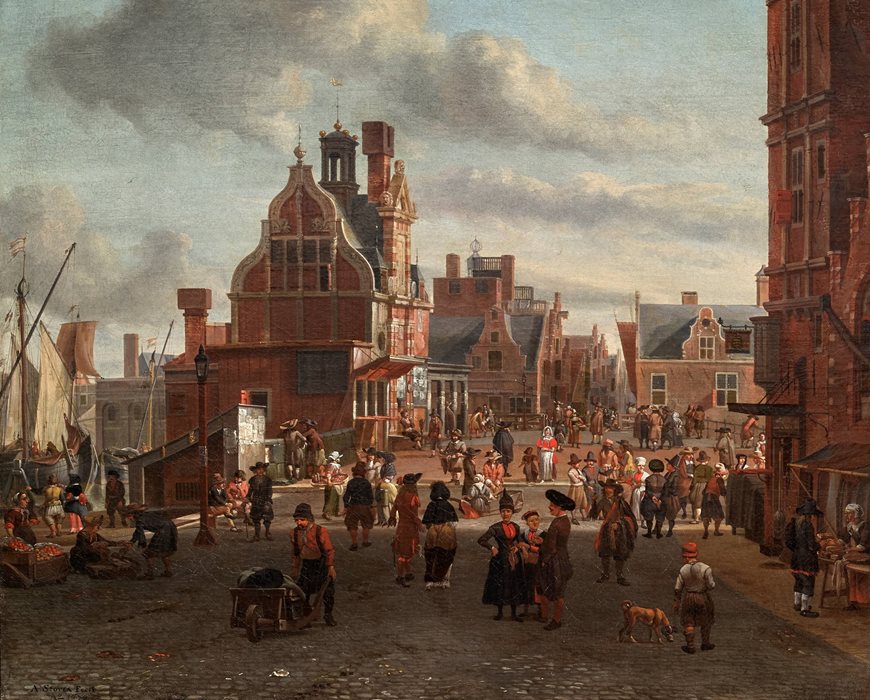
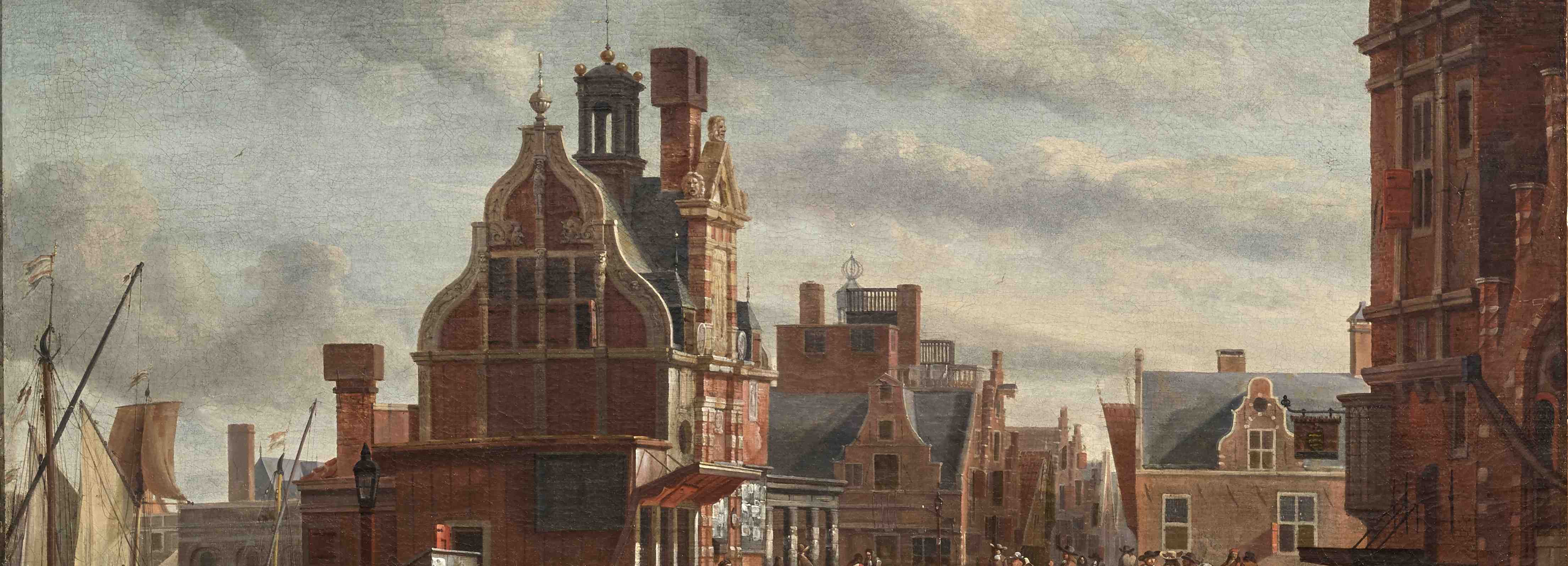
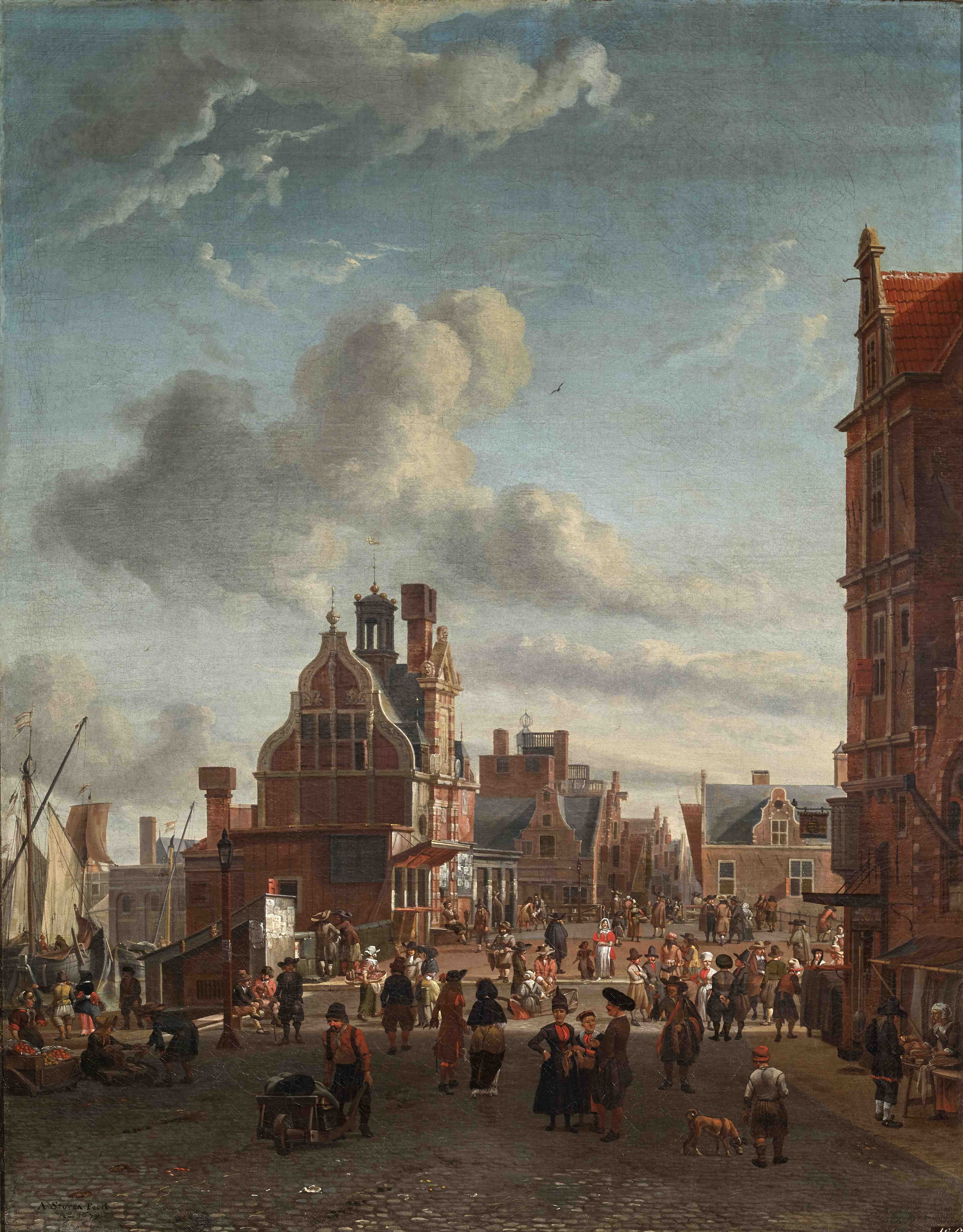
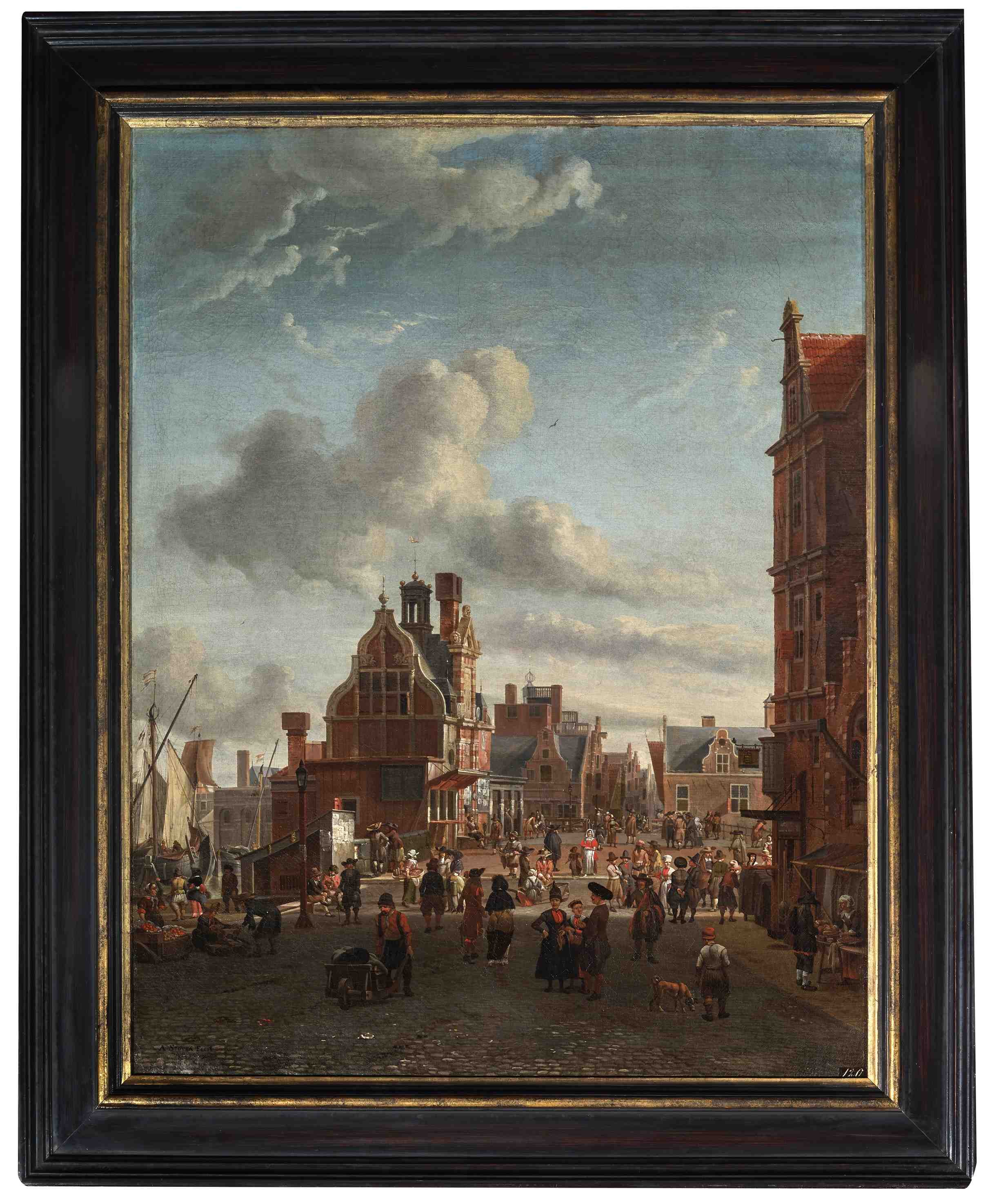
A View of the West of the Nieuwe Brug in Amsterdam, site of the World’s First Stock Exchange, and the Paalhuis.
Oil on Canvas, 85 x 65 cm.
Signed and dated lower left: A. Storck 1679
Provenance
Collection August Schmöle, Germany, Iserlohn, 1883;
Collection Theodor Schmöle (son of August), Germany;
Collection Mrs Theodor Schmöle, Mammern, Switzerland, from 1919;
By descent, Private Collection, Switzerland, -2021.
Catalog des Gemälde-Sammlung des Herrn Aug. Schmöle in Iserlohn, 1883, no. 120.
Additionnal Information
Our painting can be related to what is most probably its preparatory drawing from 1679 by Abrahan Storck, coming from the Van Eeghen Collection and now in the Gemeente Amsterdam Stadsarchief.
The bridge is the Nieuwe Brug, which is still there, opposite Central Station. This bridge at the head of the Damrak was a popular meeting place in the 16th and 17th century, where Amsterdammers exchanged the latest news and messages. The New Bridge was originally made of wood; in 1561 the bridge was bricked and designated by the City Council of Amsterdam as one of the official places to trade commodities. Further “The trade in VOC shares started in 1602… the best chance by far of finding someone who wanted to buy or sell a share was on the New Bridge or St Olaf’s Church.” (see L. Petram, The World’s First Stock Exchange, 2014 Columbia University Press, p.31). The Oude Brug was further down the Damrak, in the direction of Dam. At the Oude Brug was the Accijnshuis, where the import duties on beer and wine were collected. There is also the stone building of Het Zeerecht in the background to the left of the Paalhuis. The Sea of Justice on the Kampersteiger hosted the College of Maritime Affairs, which dealt with conflicts between merchants, shipowners, skippers, sailors and loaders.
The Paalhuis is the building across the bridge on the left. In front of it, the street life on the bridge over the Damrak, is vividly and cheerfully depicted: barking dogs, people talking to each other or leaning over the bridge watching what is happening on the water. In addition numerous Jewish people can be seen on the Bridge: they were very well-known for trading commodities and shares.
Whoever entered the city from the IJ and had passed the double row of poles that defended the city in dangerous times, first came to the Paalhuis. Here people had to pay a stake or port fee. The stake money was a levy on ships that reached the Zuiderzee from the North Sea. With the money collected, marks in the sea (such as beacons and tons) had to be paid for. In 1527, Amsterdam took over the right to collect money from Kampen. The Prince of Orange granted the right to Enkhuizen in 1573. In the Paalhuis, the ships entering were registered in the port books. It also served as a post office.
With the creation of the Vereenigde Osst-Indische Compagnie or VOC (Dutch East India Company) in 1602, the world saw the start of large scale trading of stocks and hence Amsterdam is consequently entitled to claim that it was the cradle of the first stock Exchange (see L. Petram, Op-sit supra, p. 237).
Abraham Jansz. Storck was baptized in Amsterdam in 1644; he died after 1704. Storck painted, drew and etched beaches, seas, still waters, turbulent waters, ships and barges. Storck made his sea pieces and harbor views along the lines of Willem van de Velde the Younger and Ludolf Bakhuizen.


YOU MAY ALSO LIKE